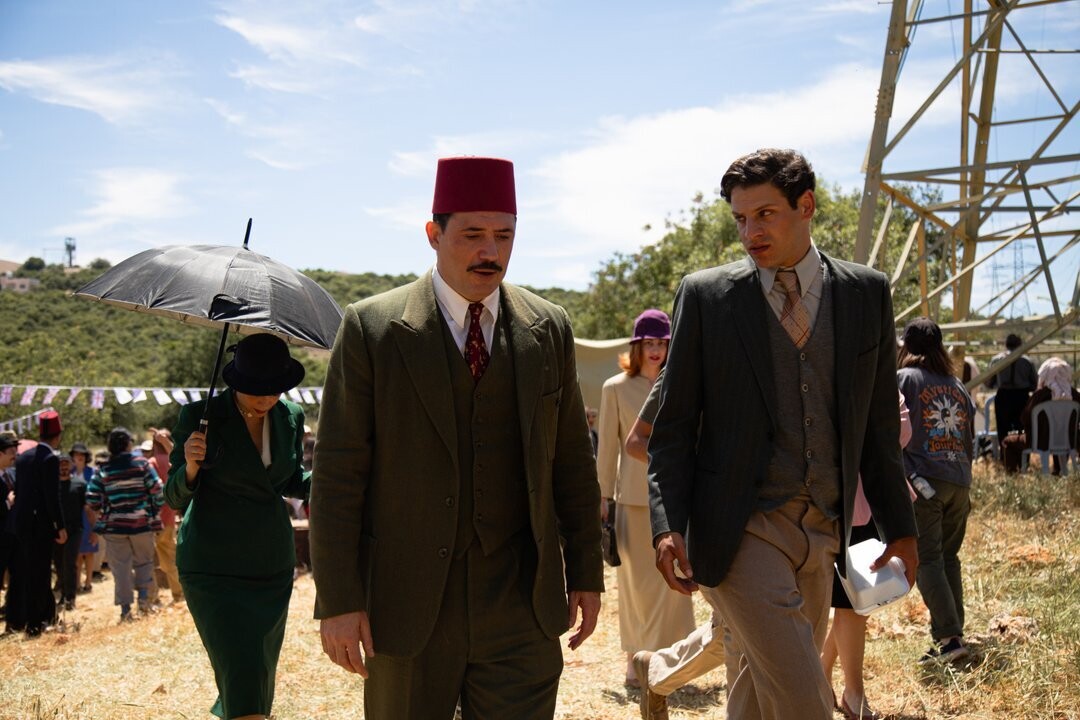
Palestinian director Annemarie Jacir returns to one of the least addressed episodes in her people's history in 'Palestine 36', a feature film that reconstructs the 1936 Arab revolt against the British mandate. According to its author, the film is fundamental to understanding the roots of the Israeli-Palestinian conflict. The film was pre-selected for the Oscar for Best International Feature. Jacir began writing the project nine years ago, but the shoot was interrupted by the current situation. The subsequent Israeli offensive in Gaza has caused tens of thousands of Palestinian casualties in a conflict that continues to escalate. The cast includes Jeremy Irons, Hiam Abbass, Robert Aramayo, Liam Cunningham, Yasmine Al Massri, Saleh Bakri, and Billy Howle, among others. Faced with this scenario, the shoot had to be moved to Jordan. 'It was a financial disaster,' the filmmaker acknowledged in an interview with the AFP agency, although she admitted that the pre-selection for the Oscars is a symbolic and professional relief. In the dominant historical narrative, the Palestinian narrative usually begins with the Nakba of 1948, when more than half of the Arab population was displaced after the creation of the State of Israel. For Jacir, however, the 1936-1939 revolt occupies a central and little-explored place. The fear of losing land was one of the main drivers of the conflict, especially in rural areas. 'Palestine 36' follows the story of Yusuf, a peasant who works for an influential editor of an Arabic newspaper in Jerusalem and gets caught up in the middle of the revolt. The film focuses on British repression, represented by historical figures such as High Commissioner Arthur Wauchope and General Charles Tegart. According to Jacir, this is the first Palestinian film to be released in theaters since the start of the current war. 'Cinema is not going to save us, but it is a refusal to disappear,' she states. On October 7, 2023, when filming was about to begin, the Islamist group Hamas launched an unprecedented attack on Israel that left more than 1,200 dead. In this sense, the director rules out the two-state solution and proposes, as a horizon, coexistence in a single shared territory. 'It is as important as what came after, because it lays the foundation for everything,' she states. This armed uprising united peasants and urban elites against the British administration and its support for a 'national Jewish home' in Palestine, in a context marked by the migration of Jews fleeing persecution in Europe.